

The Sustainable Finance Disclosure Regulation (SFDR) is an evolving set of EU rules that aims to create a level playing field for how sustainable investment strategies are classified by asset managers. As its use becomes more widespread, enhancements are added every few years. Sustainable investors welcome the SFDR as an opportunity to clarify the definition of a ‘sustainable fund’ and combat the growing threat of greenwashing.

Our Glossary of Sustainable Investing explains the main ingredients:
SFDR classification reflects the sustainability of Robeco’s fund range
The SFDR regulation forces asset managers to disclose the level of sustainability integration for their different strategies. These are now classified as Article 6, 8 or 9.
Article 6 funds do not promote environmental social or governance (ESG) factors.
Article 8 funds include environmental or social characteristics in the investment process.
Article 9 funds pursue a specific sustainability objective such as climate benchmarks.
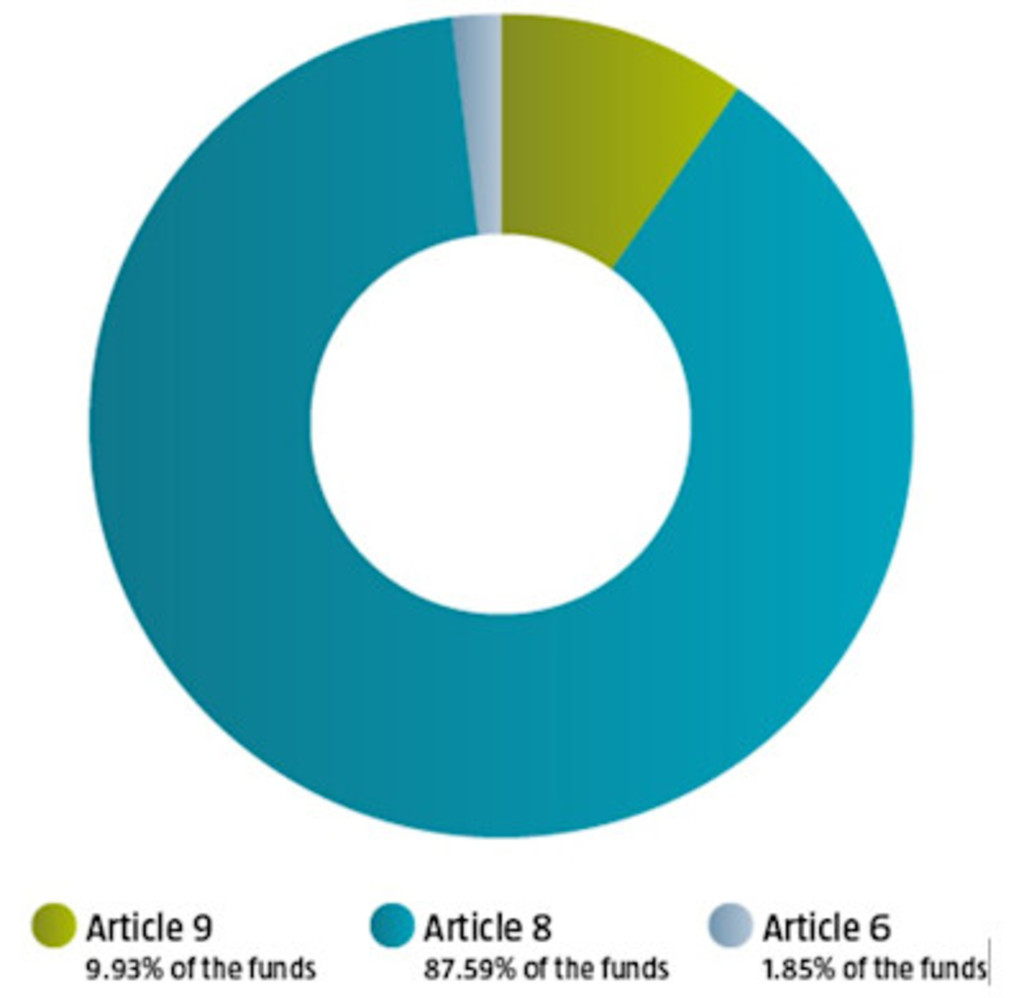
Almost all of Robeco’s funds are aligned to Article 8 or 9 of the EU’s new sustainability regulations.
Figure 1. Robeco funds are 98% Article 8 or 9
Source: Robeco, April 2026.
SFDR and transition investing
The SFDR is part of the wider Sustainable Finance Action Plan and European Green Deal, which are specifically aligned with the Paris Agreement. This seeks to limit global warming to maximum 2 °C above pre-industrial levels by 2100, and more ideally to limit it to 1.5 °C.
The 1.5 °C target requires the world to achieve net zero emissions by 2050. However, we are currently way off track from meeting it. The latest climate research shows that the world has already warmed by 1.2 °C – and possibly even more – with carbon emissions still rising. If left unchecked, the world will warm by around 2.4 °C by the end of this century, a level that could cause catastrophic and irreversible climate change.
Subsequently, the race is on to find ways to cut reliance on fossil fuels, move to renewable sources of energy, electrify key areas such as transport, and find more sustainable forms of construction. It requires a transition to a low-carbon economy that is unprecedented in human history, requiring trillions in investment capital for the solutions to the global problem.
Robeco has therefore developed a whole repertoire of potential investment solutions, from bespoke transition investments and funds looking at Smart Energy, to Paris-aligned benchmarks, strategies targeting the Sustainable Development Goals (SDGs), and targeted decarbonization products. All are backed by decades of experience in integrating ESG into the investment process, with a heightened focus on the environmental aspect, as climate change is tackled head-on.
SFDR: It does what it says on the tin
Rather than viewing the SFDR as more red tape regulation, most investors have embraced it as achieving three main goals. First, it creates an agreed framework for a sustainable investment, with clear definitions behind the three articles. Investors within the EU can no longer interpret legislation at will, as many such interpretations have been conflicting or prone to greenwashing in the past, where the true contribution to net zero is overstated.
Second, the articles make clear what levels of sustainability the investments contain, providing the investing public with greater confidence and clarity. The Robeco Global Climate Survey 2024 highlighted greenwashing as one of the biggest fears that investors have when it comes to sustainable investing.
In total, the articles have provided a backdrop for what a UK advertising campaign once described as ‘It does what it says on the tin’. An Article 8 fund does attempt to contain some element of sustainability, whereas an Article 6 fund does not try to.
Is SFDR Article 9 better? Not necessarily…
The third benefit is more surprising as it has led to a greater focus on the level of transition that is encompassed by the Articles. When they first came out in 2021, many perceived Article 9 as logically being better than Article 8, since it only allowed companies that were provably sustainable into the investment fund. Since then, the focus has moved on to transition, rather than fixating on companies that are already ‘oven ready’.
This has ironically led to more investors preferring Article 8 funds, since the companies within are somewhere on their journey to become sustainable, particularly regarding achieving net zero. These can offer greater potential than Article 9 funds, for whom the transition has largely already been achieved. As another saying goes, ‘Often it is better to travel than to arrive’.
And since very few companies, along with the funds that hold them, are already 100% sustainable, it means there is a far greater choice for Article 8 funds than for Article 9. As shown above, this is reflected in Robeco’s own assets under management, for which 87.6% are Article 8 and 9.9% are Article 9. Article 6 funds are generally avoided, as they do not attempt to contain sustainability, and at Robeco are confined to cash or derivatives-based products.
The next steps – SFDR 2.0
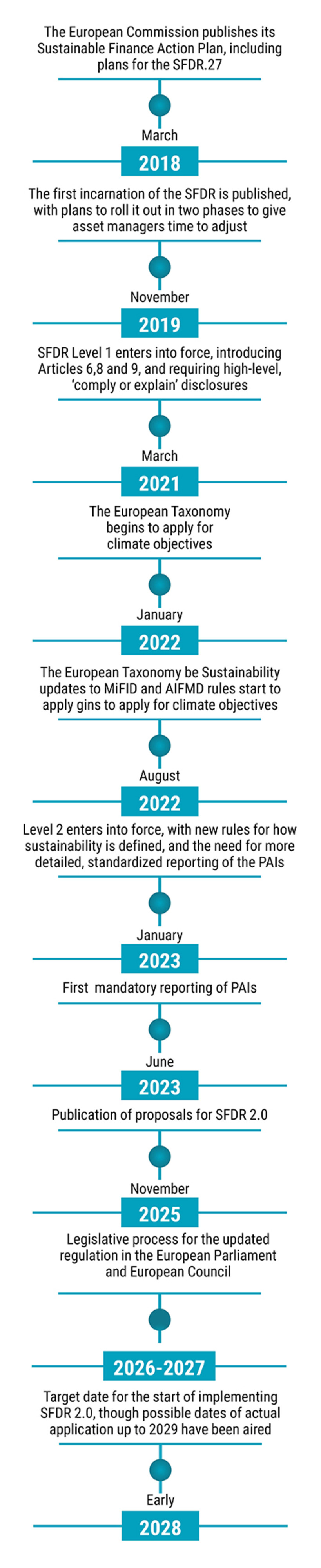
Sustainable investing is constantly changing, so the original SFDR regulation is getting an upgrade over the coming years with what is being called ‘SFDR 2.0’. The update was proposed by the European Commission in November 2025 and will go through the full EU legislative process before coming into force. The earliest possible application date is expected to be around the beginning of 2029, but this will depend on how quickly the negotiations go.
The likely timeline is shown below. However, it should be noted that the regulatory trajectory is long, politically sensitive, and subject to intense scrutiny from within the EU. It is therefore not guaranteed that the current proposal will remain in its present form, or that it will be enacted at all.
Figure 2: SFDR 2.0 projected timeline

Source: EU, Robeco 2026
The revised regulation introduces a new product categorization system with three labels – ’ESG Basics’, ‘Transition’ and ‘Sustainable’. The ESG Basics category will replace Article 8 requirements, while Sustainable will replace Article 9, and a new Article 7 will be introduced for the Transition bucket. Article 6 for no use of ESG stays the same. Each category comes with a set of eligibility criteria, including minimum investment commitments and mandatory exclusions.

Quarterly sustainable regulatory update
In this series of quarterly updates, we will summarize what we believe to be important and relevant for investors
関連するインサイト記事