Insight

Quant chart: The Walking Dead of the equity market

As Halloween fast approaches, we take a look at one of the creepier corners of the equity market: firms that can barely cover their interest expenses, yet remain alive. How much weight do these ‘zombie firms’ carry in large- and small-cap indices, how has this evolved over time – and what does this mean for passive strategies versus their active counterparts?

Authors

    Researcher

The concept of zombie firms dates back to Japan’s ‘lost decade’ in the 1990s, when banks propped up insolvent borrowers to avoid realizing losses.1 Pointing to a rise in zombie firms globally after the global financial crisis and the Covid pandemic, later studies have typically defined zombie firms as those for which operating income is less than interest expense, i.e., having an interest coverage ratio below one for three consecutive years.2

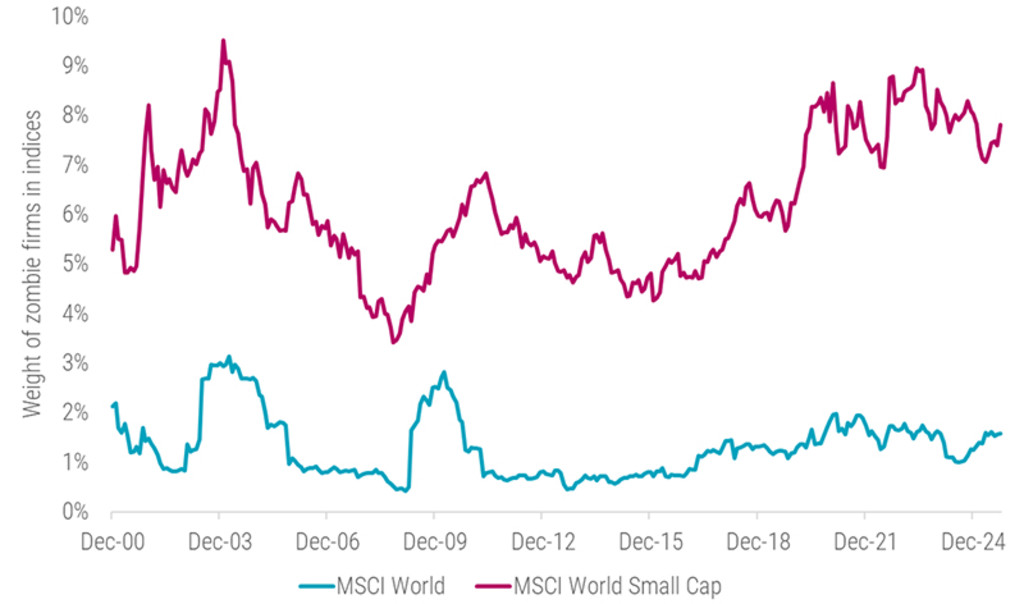
Figure 1 | Weight of zombie firms in indices

Source: Robeco, LSEG. The chart shows the weight of zombie firms (interest coverage ratio below one for three consecutive years) in the MSCI World and MSCI World Small Cap indices from December 2000 to September 2025.

Figure 1 shows the weight of zombie firms in the MSCI World (blue line) and MSCI World Small Cap (red line) indices over time. Zombie firms make up only a little more than 1% in the mid- and large-cap space of the MSCI World, and apart from the rise following the dot-com bubble and the global financial crisis, the increase in recent years has been modest. In contrast, zombie firms on average account for more than 6% of the MSCI Small Cap Index over the sample period. Their weight rose from less than 5% ten years ago to 7.8% at the end of September 2025. 3

The difference between the two indices reflects that small caps are typically less mature firms; often less profitable with weaker bargaining power with lenders. While the MSCI World Index represents a far higher share of the total equity market than the MSCI World Small Cap Index (85% vs. 14%), the number of constituents is much higher in the small-cap segment (3,855 vs. 1,320), underscoring its importance for the broader economy.

Why does this matter? Zombie firms are often accused of negatively affecting productivity, capital allocation, and entrepreneurship. They tie up labor, credit, and investor capital that could otherwise flow to healthier firms. Passive strategies that purely replicate market indices without assessing the quality of the underlying companies may inadvertently support their survival.

In contrast, active strategies not only offer alpha potential, but also play an important role in directing capital toward stronger and more sustainable business models. Fundamental investors do so through deep company analysis and selective conviction. Quantitative investors, meanwhile, take a systematic approach; making thousands of small, data-driven active bets that, together, can steer capital efficiently away from ‘zombie firms’ and toward those with enduring financial strength.


Footnotes

1 Caballero, R. J., Hoshi, T., and Kashyap, A. K. (2008). ‘Zombie lending and depressed restructuring in Japan’, American Economic Review, 98(5).
2 See McGowan, M. A., Andrews, D., and Millot, V. (2017). ‘The walking dead? Zombie firms and productivity performance in OECD countries’, OECD Economic Department Working Papers No. 1372, Banerjee, R., and Hofmann, B. (2018). ‘The rise of zombie firms: causes and consequences’, BIS Quarterly Review, September 2018, and Albuquerque, B., & Iyer, R. (2024). ‘The rise of the walking dead: Zombie firms around the world’, Journal of International Economics, 152.
3 When measured by the fraction of companies rather than market weight, the share of zombie firms is slightly higher for both indices.


Get the latest insights

Subscribe to our newsletter for investment updates and expert analysis.

Don’t miss out

Let's keep the conversation going

Keep track of fast-moving events in sustainable and quantitative investing, trends and credits with our newsletters.

Don’t miss out

Robeco aims to enable its clients to achieve their financial and sustainability goals by providing superior investment returns and solutions.

Important information This disclaimer applies to any documents and the verbal or written comments of any person in presentations or webinars on this website and taken together is referred to herein as the “Information”. The services to which the Information relate are NOT FOR RETAIL CLIENTS - The information contained in the Website is solely intended for professional investors, defined as investors which (1) qualify as professional clients within the meaning of the Markets in Financial Instruments Directive (MiFID), (2) have requested to be treated as professional clients within the meaning of the MiFID or (3) are authorized to receive such information under any other applicable laws and must not be relied or acted upon by any other persons. This Information does not constitute an offer to sell, or a solicitation of an offer to buy, any financial product, and may not be relied upon in connection with the purchase or sale of any financial product. You are cautioned against using this Information as the basis for making a decision to purchase any financial product. To the extent that you rely on the Information in connection with any investment decision, you do so at your own risk. The Information does not purport to be complete on any topic addressed. The Information may contain data or analysis prepared by third parties and no representation or warranty about the accuracy of such data or analysis is provided.
In all cases where historical performance is presented, please note that past performance is not a reliable indicator of future results and should not be relied upon as the basis for making an investment decision. Investors may not get back the amount originally invested. Neither Robeco Institutional Asset Management B.V. nor any of its affiliates guarantees the performance or the future returns of any investments. If the currency in which the past performance is displayed differs from the currency of the country in which you reside, then you should be aware that due to exchange rate fluctuations the performance shown may increase or decrease if converted into your local currency. Robeco Institutional Asset Management B.V. (“Robeco”) expressly prohibits any redistribution of the Information without the prior written consent of Robeco. The Information is not intended for distribution to, or use by, any person or entity in any jurisdiction or country where such distribution or use is contrary to law, rule or regulation. Certain information contained in the Information includes calculations or figures that have been prepared internally and have not been audited or verified by a third party. Use of different methods for preparing, calculating or presenting information may lead to different results. Robeco Institutional Asset Management UK Limited (“RIAM UK”) is authorised and regulated by the Financial Conduct Authority. RIAM UK, 30 Fenchurch Street, Part Level 8, London EC3M 3BD (FCA Reference No:1007814). The company is registered in England and Wales under Ref No. 15362605.

In all cases where historical performance is presented, please note that past performance is not a reliable indicator of future results and should not be relied upon as the basis for making an investment decision. Investors may not get back the amount originally invested. Neither Robeco Institutional Asset Management B.V. nor any of its affiliates guarantees the performance or the future returns of any investments. If the currency in which the past performance is displayed differs from the currency of the country in which you reside, then you should be aware that due to exchange rate fluctuations the performance shown may increase or decrease if converted into your local currency. Robeco Institutional Asset Management B.V. (“Robeco”) expressly prohibits any redistribution of the Information without the prior written consent of Robeco. The Information is not intended for distribution to, or use by, any person or entity in any jurisdiction or country where such distribution or use is contrary to law, rule or regulation. Certain information contained in the Information includes calculations or figures that have been prepared internally and have not been audited or verified by a third party. Use of different methods for preparing, calculating or presenting information may lead to different results. Robeco Institutional Asset Management B.V. is authorised as a manager of UCITS and AIFs by the Netherlands Authority for the Financial Markets and subject to limited regulation in the UK by the Financial Conduct Authority. Details about the extent of our regulation by the Financial Conduct Authority are available from us on request.