



• Insight
Achieving your investment goals with factors: get specific factor exposure
Factor-based strategies can help investors get exposure to a particular factor. Fifth article of a series on how factors can help investors achieve specific goals.
Summary
- Exposures to individual factors matter
- Single-factor strategies help adjust exposures
- Avoiding clashes is key
Well before factor investing became popular in the late 2000s, many investors were already exploiting individual factor premiums. Value strategies are a good example. The value effect is the empirically-documented tendency of inexpensive securities to achieve above-market returns relative to their intrinsic value as measured for example by the book-to-price ratio of a company.
For decades, prominent investors have advocated buying securities trading below their intrinsic value and many traditional active managers have been offering so-called value strategies. As early as the 1930s,1 Benjamin Graham and David Dodd of Columbia Business School advocated investing in undervalued stocks. Later on, Warren Buffett became famous for his very successful investment philosophy largely based on this same principle.
In this context, many investors have recently turned to factor investing as a systematic and cost-efficient way to achieve exposure to a particular factor premium, such as value or momentum, or to a specific set of factors. In fact, a recent FTSE Russell survey of asset owners found that getting specific factor exposure ranked fifth among the top investment goals that led them to consider factor-based strategies.
Scientific basis
As discussed in a previous article in this series, decades of academic research have shown that strategies focusing on a handful of well-vetted factor premiums deliver statistically and economically significant abnormal returns. These factor premiums are distinct phenomena, which exist beside one another, and have been identified across markets and asset classes.2
Targeting different factor premiums will therefore normally lead to different investment outcomes. Figure 1 provides an illustration of this. It shows the Sharpe and information ratios generated with four generic single-factor strategies – based on popular equity indices like the MSCI World Value Weighted index, the MSCI World Momentum index, the MSCI World Minimum Volatility index or the MSCI World Quality index – investing global equity markets, over the period from June 1988 to December 2015.
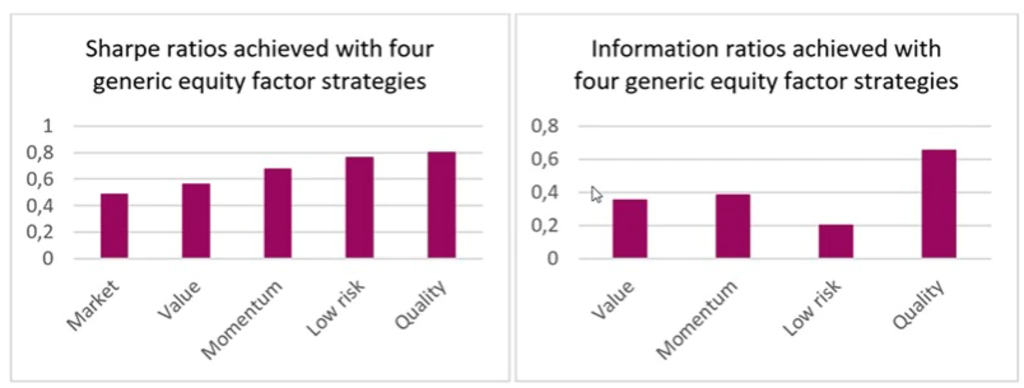
Source: Blitz, Huij, Lansdorp and van Vliet, ‘Efficient factor investing strategies’, Robeco whitepaper, 2016. Excess returns were measured relative to the MSCI World index from June 1988 to December 2015. Returns were measured in USD. The MSCI Value Weighted Index, MSCI Momentum Index, MSCI Minimum Volatility Index and MSCI Quality Index were used for generic factor strategies. The value of your investments may fluctuate. Results obtained in the past are no guarantee for the future.
The differences between different single-factor strategies are not only visible over long periods of time. In the shorter term, for instance, factor premiums can experience periods of underperformance or outperformance, relative to the market as well as other factor premiums. Such periods can continue uninterrupted for several years.
All these findings illustrate how different factors perform independently over time. It therefore makes sense to consider exposures individually and to allocate to each individual factor, depending on the needs and priorities of each investor, using single-factor strategies. For example, investors that have a clear preference for income, can allocate more to value or low volatility strategies, which typically deliver high dividends. Other investors may prefer to limit turnover, and therefore choose not to allocate to momentum which tends to lead to higher portfolio rotation.
Other considerations
But while monitoring and adjusting individual factor exposures depending on the strategic interests of each investor may look like a simple task on paper, there is much more to it in practice. The body of academic literature on the subject is extensive and there are many products available in the market for quantitative factor exposure measurement and performance attribution, including Robeco’s own tool.
Nevertheless, accurately measuring exposures to these factors often remains a challenge, in particular for the less sophisticated investors, who typically lack the necessary resources. Many academics and practitioners have warned about the dangers of poorly designed or inappropriate models.3
Without the relevant measurement tools, investors may, for example, confuse systematic exposure to one particular factor with alpha generated by an active portfolio manager. This explains why asset managers increasingly offer (multi-factor) solutions that provide exposure to a preset blend of factors.
Another important pitfall for those looking for specific factor exposures has to do with the way factors interact and in some cases clash with each other. Generic single-factor strategies usually ignore these interactions and therefore provide suboptimal factor exposures, resulting in, e.g. a value strategy that has very negative momentum exposures.4 This underscores the need for efficient factor strategies that use enhanced factor definitions that prevent negative exposures to other proven factors.
Footnotes
1Benjamin Graham and David Dodd, ‘Security analysis’, 1934
2See for example our recently published book of collected research articles: G. Baltussen, M. Martens, P. van Vliet, ‘Quant Allocation - Collected Robeco Articles’, 2018.
3See for example: Israel R. and Ross A., ‘Measuring Factor Exposures: Uses and Abuses’, The Journal of Alternative Investments”, 2017.
4For more information, see for example: Blitz D. and Vidojevic M., ‘The Characteristics of Factor Investing’, Robeco working paper, 2018.
Discover the value of quant
Subscribe for cutting-edge quant strategies and insights.
Important information
THIS WEBSITE IS SOLELY INTENDED FOR PROFESSIONAL INVESTORS, WHICH HAS THE MEANING ASCRIBED TO IT IN THE SECURITIES AND FUTURES ORDINANCE (CAP. 571 OF THE LAWS OF HONG KONG) AND ITS SUBSIDIARY LEGISLATION. Investment involves risks. Past performance is not indicative of future performance. The information contained in this website is provided for reference only and does not constitute investment advice or an offer or solicitation to buy or sell in any securities or to adopt any investment strategy. Investors should not base their investment decisions solely on the information provided on this website and are advised to seek independent advice (including advice on tax implications) before making any investment decisions. Investors should ensure they fully understand the risks associated with the investment products and should also consider their own investment objectives and risk tolerance level. The investment decision is yours. You should not invest unless the intermediary who sells you the investment products has advised you that it is suitable for you and has explained how it is consistent with your investment objectives. Please refer to the relevant offering documents or other legal documents for further details including the risk factors. This website is published by Robeco Hong Kong Limited which is regulated by the Hong Kong Securities and Futures Commission (“SFC”) (CE No. APU851). This website has not been reviewed by the SFC. No assurance can be given that the investment objective of any investment products will be achieved. No representation or promise as to the performance of any investment products or the return on an investment is made. The value of investments may fluctuate. Past performance, projections, or forecasts included in this website should not be regarded as guarantees or indications of future performance, and no express or implied warranty is provided. The contents of this website are based on sources believed to be reliable, but due to the nature of information delivery technology and the necessity of using multiple data sources, including third party content, their accuracy is not guaranteed. The opinions expressed are as of the date shown above and may change as market conditions evolve, and are subject to change without notice. These opinions may differ from those of other Robeco investment professionals. Robeco accepts no liability for any direct, indirect, or consequential loss arising from the use of this material or any comments, opinions, or estimates contained herein. Robeco has no duty to update this website or any website content. Materials on this website may not be reproduced, distributed, or published without prior written permission from Robeco. Unless otherwise specified, Source: Robeco.