Researcher
Get the latest insights
Subscribe to our newsletter for investment updates and expert analysis.






As Halloween fast approaches, we take a look at one of the creepier corners of the equity market: firms that can barely cover their interest expenses, yet remain alive. How much weight do these ‘zombie firms’ carry in large- and small-cap indices, how has this evolved over time – and what does this mean for passive strategies versus their active counterparts?



The concept of zombie firms dates back to Japan’s ‘lost decade’ in the 1990s, when banks propped up insolvent borrowers to avoid realizing losses.1 Pointing to a rise in zombie firms globally after the global financial crisis and the Covid pandemic, later studies have typically defined zombie firms as those for which operating income is less than interest expense, i.e., having an interest coverage ratio below one for three consecutive years.2
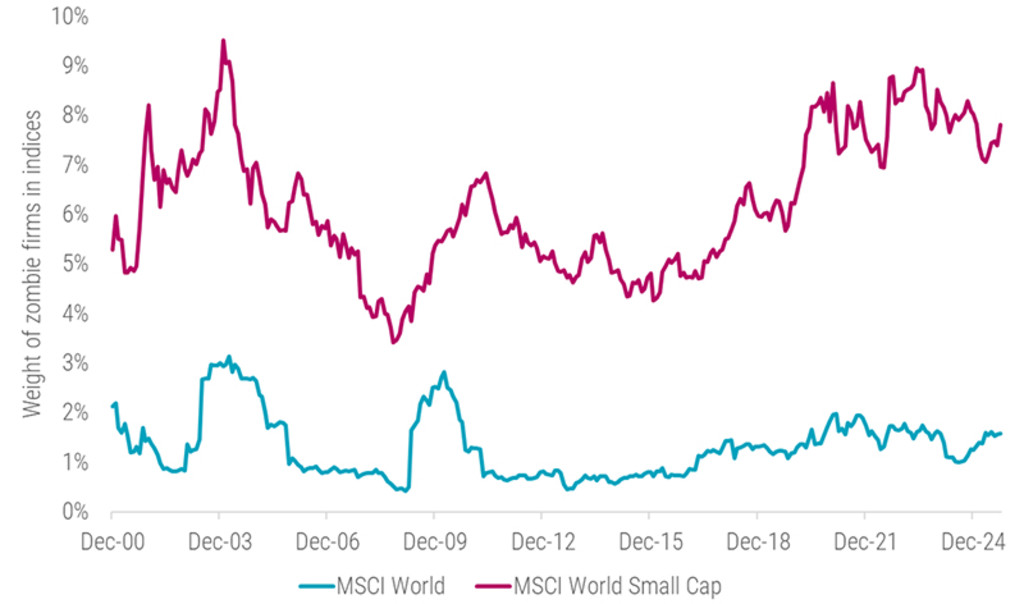
Source: Robeco, LSEG. The chart shows the weight of zombie firms (interest coverage ratio below one for three consecutive years) in the MSCI World and MSCI World Small Cap indices from December 2000 to September 2025.
Figure 1 shows the weight of zombie firms in the MSCI World (blue line) and MSCI World Small Cap (red line) indices over time. Zombie firms make up only a little more than 1% in the mid- and large-cap space of the MSCI World, and apart from the rise following the dot-com bubble and the global financial crisis, the increase in recent years has been modest. In contrast, zombie firms on average account for more than 6% of the MSCI Small Cap Index over the sample period. Their weight rose from less than 5% ten years ago to 7.8% at the end of September 2025. 3
The difference between the two indices reflects that small caps are typically less mature firms; often less profitable with weaker bargaining power with lenders. While the MSCI World Index represents a far higher share of the total equity market than the MSCI World Small Cap Index (85% vs. 14%), the number of constituents is much higher in the small-cap segment (3,855 vs. 1,320), underscoring its importance for the broader economy.
Why does this matter? Zombie firms are often accused of negatively affecting productivity, capital allocation, and entrepreneurship. They tie up labor, credit, and investor capital that could otherwise flow to healthier firms. Passive strategies that purely replicate market indices without assessing the quality of the underlying companies may inadvertently support their survival.
In contrast, active strategies not only offer alpha potential, but also play an important role in directing capital toward stronger and more sustainable business models. Fundamental investors do so through deep company analysis and selective conviction. Quantitative investors, meanwhile, take a systematic approach; making thousands of small, data-driven active bets that, together, can steer capital efficiently away from ‘zombie firms’ and toward those with enduring financial strength.
1 Caballero, R. J., Hoshi, T., and Kashyap, A. K. (2008). ‘Zombie lending and depressed restructuring in Japan’, American Economic Review, 98(5).
2 See McGowan, M. A., Andrews, D., and Millot, V. (2017). ‘The walking dead? Zombie firms and productivity performance in OECD countries’, OECD Economic Department Working Papers No. 1372, Banerjee, R., and Hofmann, B. (2018). ‘The rise of zombie firms: causes and consequences’, BIS Quarterly Review, September 2018, and Albuquerque, B., & Iyer, R. (2024). ‘The rise of the walking dead: Zombie firms around the world’, Journal of International Economics, 152.
3 When measured by the fraction of companies rather than market weight, the share of zombie firms is slightly higher for both indices.
Subscribe to our newsletter for investment updates and expert analysis.
THIS WEBSITE IS SOLELY INTENDED FOR PROFESSIONAL INVESTORS, WHICH HAS THE MEANING ASCRIBED TO IT IN THE SECURITIES AND FUTURES ORDINANCE (CAP. 571 OF THE LAWS OF HONG KONG) AND ITS SUBSIDIARY LEGISLATION. Investment involves risks. Past performance is not indicative of future performance. The information contained in this website is provided for reference only and does not constitute investment advice or an offer or solicitation to buy or sell in any securities or to adopt any investment strategy. Investors should not base their investment decisions solely on the information provided on this website and are advised to seek independent advice (including advice on tax implications) before making any investment decisions. Investors should ensure they fully understand the risks associated with the investment products and should also consider their own investment objectives and risk tolerance level. The investment decision is yours. You should not invest unless the intermediary who sells you the investment products has advised you that it is suitable for you and has explained how it is consistent with your investment objectives. Please refer to the relevant offering documents or other legal documents for further details including the risk factors. This website is published by Robeco Hong Kong Limited which is regulated by the Hong Kong Securities and Futures Commission (“SFC”) (CE No. APU851). This website has not been reviewed by the SFC. No assurance can be given that the investment objective of any investment products will be achieved. No representation or promise as to the performance of any investment products or the return on an investment is made. The value of investments may fluctuate. Past performance, projections, or forecasts included in this website should not be regarded as guarantees or indications of future performance, and no express or implied warranty is provided. The contents of this website are based on sources believed to be reliable, but due to the nature of information delivery technology and the necessity of using multiple data sources, including third party content, their accuracy is not guaranteed. The opinions expressed are as of the date shown above and may change as market conditions evolve, and are subject to change without notice. These opinions may differ from those of other Robeco investment professionals. Robeco accepts no liability for any direct, indirect, or consequential loss arising from the use of this material or any comments, opinions, or estimates contained herein. Robeco has no duty to update this website or any website content. Materials on this website may not be reproduced, distributed, or published without prior written permission from Robeco. Unless otherwise specified, Source: Robeco.
Warning – Fraudulent use of Robeco on websites and social media Read more