

Head of Multi Asset & Equity Solutions, Co-Head Investment Solutions


• Monthly outlook
Tariffs retaliation – the markets bite back
It’s been the expected explosive start to the second Trump presidency, but he will have been reminded of forces more powerful than presidential authority – the markets. And that could serve to neutralize the impact of tariffs and any trade war, says multi-asset investor Colin Graham.
Authors

Summary
- Tariffs cause US equities, bonds and currency to fall at the same time
- Conversion of dollars held overseas into local assets more likely
- Investors will question the premium now needed to hold US assets
All the major asset classes tanked on the tariffs news, though the biggest shock came with a trillion-dollar sell-off in the US Treasury market – by far the largest bond market in the world. This move by the ‘bond vigilantes’ prompted the White House to water down or postpone much of the tariff plans.
And now the US economy itself is threatened by the self-defeating mantra of trying to correct trade imbalances with taxes on imports that will only dampen consumer demand and import inflation, says Graham, co-head of Robeco Investment Solutions.

The art of the deal?
“From our vantage point, President Trump is not following his own mantra of the art of the deal,” Graham says. “He blinked when the bond vigilantes emerged from hibernation, and is now folding as his bluff was called by friends and foes alike. The climbdown over tariffs will continue, but the negative macro impact on the US will start to emerge.”
“The consumer and manufacturing survey data has been poor, though the actual spending or labor data has yet to be affected. There is evidence that US consumers are pulling spending forward, and that companies have been stockpiling before the tariffs hit.”
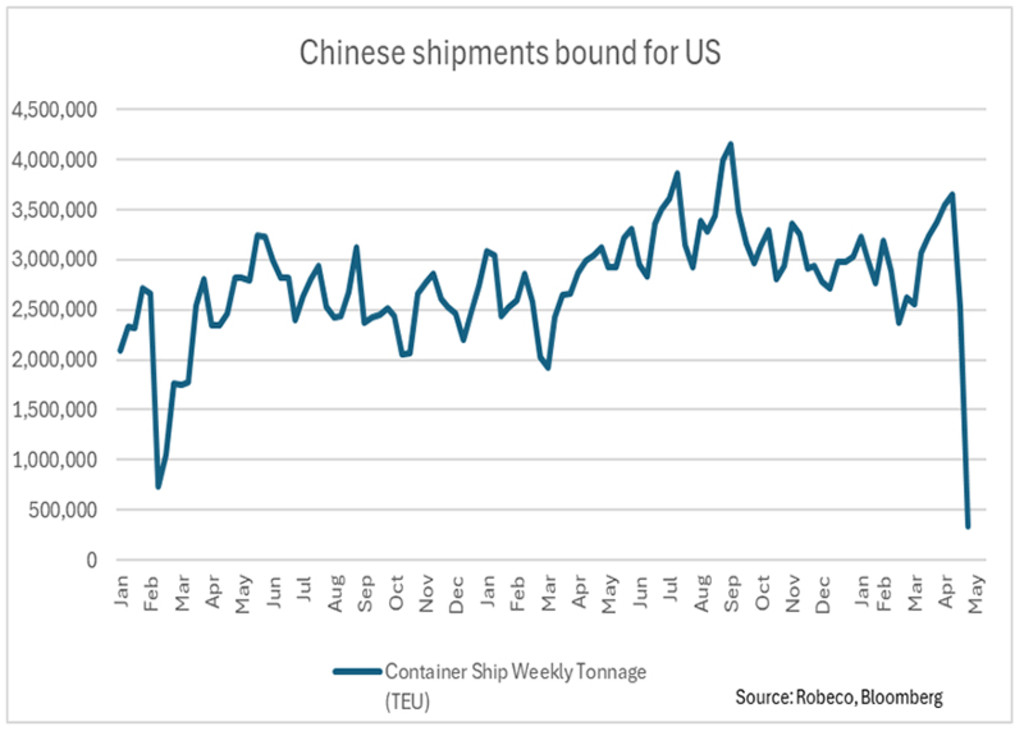
“As a consequence of the tariffs, shipping volumes from China have ground to a halt. The most recent parallels can be drawn with the supply shock of the 2020 pandemic, as goods became scarce and inflation skyrocketed.”
Figure 1: Container ship volumes: shipments bound for the US from China have fallen off a cliff
Source: Robeco, Bloomberg
Upending the world order
The first major casualty of the new regime has been a significant weakening of the US dollar, and its role as the global reserve currency that is normally highly prized by foreigners. Its historic strength has largely allowed the US to fund its huge budget and trade deficits.
“Reversing this system could have dire consequences for the US and global economy,” Graham says. “Since the tariff announcements, the US economic outlook has been universally downgraded, coupled with everyone scrambling to understand the extreme policy uncertainty.”
“Non-US investors are now questioning the required risk premium for holding US assets. This is the USD 32 trillion question (the size of foreign portfolio holdings), which means the retaliation may come from different avenues.”
Reactions of asset classes
This retaliation has major implications for all asset classes, Graham says: “We came into the year with the dollar significantly overvalued compared to history as superior growth, higher interest rates and capital inflows drove it ever higher. Over the longer term, we expect a derating and rebalancing.”
“The downward pressure from a ‘buyer’s strike’ would be extended if investors do not allocate more assets to the US. Meanwhile, the repatriation of export proceeds from the US, allowing local currencies to appreciate against the dollar, means tariff policies are likely to continue to be watered down.”
“We have already seen central banks and individuals increasing dollar diversification through gold and other FX holdings. Going forward, we question whether US interest rate and growth rate dominance over the rest of the world will be enough to retain the attraction of US capital.”
“While the reduction of overweights to US assets by foreigners is a slow burn, this could speed up, as investors and corporates accelerate the de-dollarization process.”
Impact on Treasuries
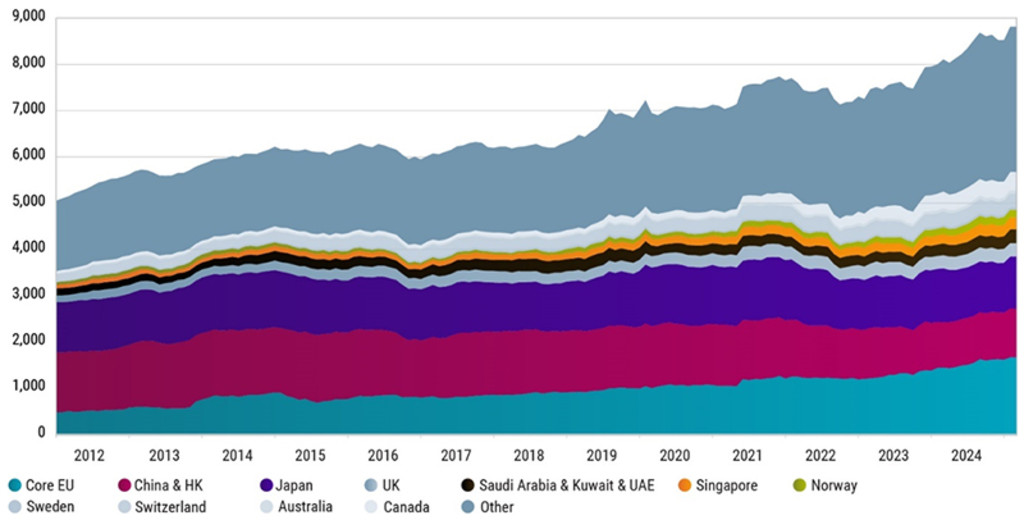
The biggest impact may be seen in US Treasuries, USD 9 trillion of which are owned by overseas actors, including China. The so-called bond vigilantes have been dumping them on the open market, forcing yields up and values down.
Figure 2: Foreign ownership of US Treasuries is huge
Source: US Department of Treasury, Robeco
“A reduction in trade will provide less incentive to hold proceeds in dollars, and the conversion of dollars held overseas into local assets becomes more likely,” Graham says. “China has been increasing its pile of US Treasuries held in the Euroclear system, thereby making it easier to switch to European bonds and avoid driving the renminbi up against the greenback.”
“We remain neutral on the duration of Treasuries as the US economy remains robust, but will be looking to add to holdings if yields rise, because the inflationary impact of the goods shortage is not yet priced in, and the risk (term) premium for holding US Treasuries should be higher.”
Outlook for earnings and equities
There are also implications for equities, not least in how any remaining tariffs cut into company earnings, at a time when many investors believe that the tech-dominated US stock market is overvalued, even after the recent correction.
“Previously, non-US investors had a cushion against any risk-off move lower in equities from a rising US dollar,” Graham says. “In the latest equity sell-off, European investors were hit with the double whammy of declining US equity prices and a falling US dollar.”
“Toward the end of 2025, it will be clearer where the additional costs of tariffs will be borne. We expect to see the cost split between corporate margins and price increases for consumers. This will impact US equity multiples, which are already expensive, and keep consumer inflation sticky.”
Murky guidance
“In this state of the world, the outlook for employment and capital expenditure intentions will significantly impact investors’ expectations. Currently, US employment data is strong, while companies’ earnings guidance has become murky to non-existent.”
“We remain hyper-vigilant on the changing landscape, currently maintaining defensive positions in portfolios.”
Get the latest insights
Subscribe to our newsletter for investment updates and expert analysis.
Important information
THIS WEBSITE IS SOLELY INTENDED FOR PROFESSIONAL INVESTORS, WHICH HAS THE MEANING ASCRIBED TO IT IN THE SECURITIES AND FUTURES ORDINANCE (CAP. 571 OF THE LAWS OF HONG KONG) AND ITS SUBSIDIARY LEGISLATION. Investment involves risks. Past performance is not indicative of future performance. The information contained in this website is provided for reference only and does not constitute investment advice or an offer or solicitation to buy or sell in any securities or to adopt any investment strategy. Investors should not base their investment decisions solely on the information provided on this website and are advised to seek independent advice (including advice on tax implications) before making any investment decisions. Investors should ensure they fully understand the risks associated with the investment products and should also consider their own investment objectives and risk tolerance level. The investment decision is yours. You should not invest unless the intermediary who sells you the investment products has advised you that it is suitable for you and has explained how it is consistent with your investment objectives. Please refer to the relevant offering documents or other legal documents for further details including the risk factors. This website is published by Robeco Hong Kong Limited which is regulated by the Hong Kong Securities and Futures Commission (“SFC”) (CE No. APU851). This website has not been reviewed by the SFC. No assurance can be given that the investment objective of any investment products will be achieved. No representation or promise as to the performance of any investment products or the return on an investment is made. The value of investments may fluctuate. Past performance, projections, or forecasts included in this website should not be regarded as guarantees or indications of future performance, and no express or implied warranty is provided. The contents of this website are based on sources believed to be reliable, but due to the nature of information delivery technology and the necessity of using multiple data sources, including third party content, their accuracy is not guaranteed. The opinions expressed are as of the date shown above and may change as market conditions evolve, and are subject to change without notice. These opinions may differ from those of other Robeco investment professionals. Robeco accepts no liability for any direct, indirect, or consequential loss arising from the use of this material or any comments, opinions, or estimates contained herein. Robeco has no duty to update this website or any website content. Materials on this website may not be reproduced, distributed, or published without prior written permission from Robeco. Unless otherwise specified, Source: Robeco.