

Chief Researcher


• Insight
Mind the gap: Effectively replacing sustainability exclusions
Sustainable investors commonly exclude the least sustainable companies, but in doing so create a gap in the portfolio. Our latest research compares various methods to replace these excluded stocks.
Authors




Researcher

Researcher
Summary
- Excluding unsustainable stocks leaves a gap that needs to be filled
- Naïve rescaling of the remaining stocks is inefficient, research shows
- We aim for better performance by using more sophisticated approaches
When it comes to sustainable investing, common examples of exclusions include the tobacco industry, companies involved with controversial weapons and thermal coal producers. However, exclusions can also be implicit, such as constraints on the carbon footprint or ESG score of the portfolio which necessitate divesting from certain stocks that score poorly on these metrics.
These exclusions result in underweight positions compared to the market portfolio, leaving a gap to be filled. In order to remain fully invested, sustainable investors must replace such underweights with overweight positions in other stocks. There are several ways to go about this, each with its own pros and cons. Since active decision making is required, sustainable investing is, by its nature, active investing; see also Blitz and de Groot (2019). The purpose of our recent research is to compare the financial performance of various methods used to replace excluded stocks.
Three approaches
The base-case, ‘naïve’ approach is to rescale the weights of remaining stocks in proportion to their market capitalizations. One concern is that this method can inadvertently bet against proven factors. Another issue is that rescaling often replaces stocks like utilities companies with heavyweight tech stocks like Apple, Microsoft, and Alphabet, introducing significant tracking error.
Our first alternative approach aims to minimize the tracking error resulting from exclusions, striving to realign closely with the return of the market index. The second alternative uses the forced underweights from exclusions to buy stocks with attractive factor characteristics, with the goal of maximizing risk-adjusted returns. In the appendix to our research we also explore a third alternative, which involves replacing exclusions with highly sustainable stocks, using alternative energy stocks as a concrete example.
Methodology and findings
For our empirical analyses, we consider two types of exclusions: carbon footprint constraints and exclusions based on Sustainable Development Goal (SDG) scores. For the carbon footprint constraint, we explore reductions of 50%, 60%, 70%, or 80% compared to the benchmark index. The SDG data is drawn from Robeco’s proprietary SDG framework, with scores ranging from -3 (worst) to +3 (best). Our sample encompasses the MSCI World (developed markets) universe from January 2006 to December 2022.
For instance, portfolios with exclusions underperformed by 2 to 4% in 2022 alone
Our initial analysis shows that the naïve approach doesn't significantly affect long-term performance, but it does introduce a large amount of tracking error. For instance, portfolios with exclusions underperformed by 2 to 4% in 2022 alone, and over periods of two to five years, such exclusions can even lead to return differences of more than 10%.
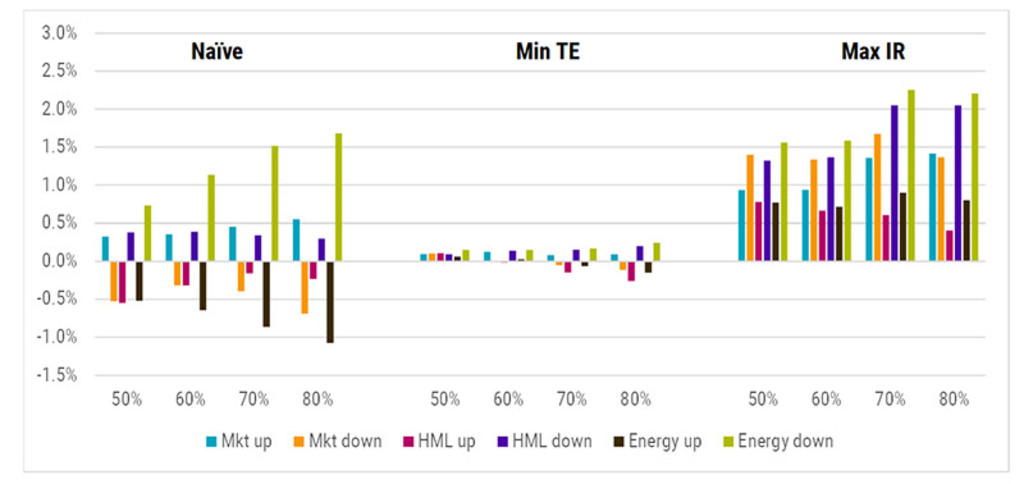
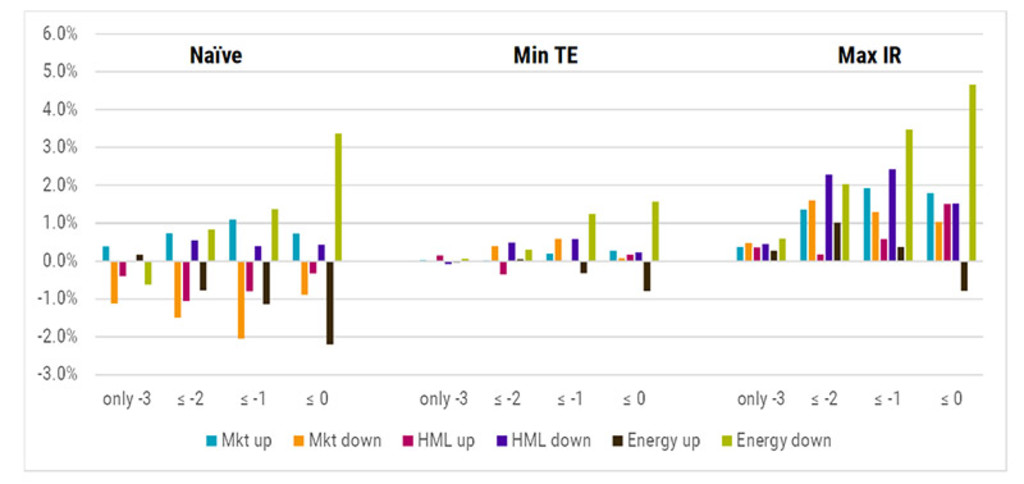
We then deploy our two advanced approaches: one minimizing tracking error and the other maximizing return. The former reduces tracking error by 50-70% for carbon constraints and 30-50% for SDG exclusions. The latter focuses on maximizing factor exposure, leading to net information ratios of about 1, signifying decent outperformances. Figure 1 compares these approaches in terms of carbon constraint and Figure 2 in terms of SDG exclusions.
Figure 1: Conditional performance of portfolios with carbon constraints
Source: Robeco
Figure 2: Conditional performance of portfolios with SDG exclusions
Source: Robeco
We find that compared to the naïve approach, both alternatives are less sensitive to various market environments. The return-optimized portfolios, in particular, manage to achieve positive expected returns in almost every scenario.
Conclusion
Sustainable investing involves exclusions that require careful portfolio rebalancing. Our research suggests that a simple rescaling approach can be inefficient and introduces unnecessary risk. However, more sophisticated approaches, either minimizing tracking error or maximizing returns, can significantly improve performance.
Important information
THIS WEBSITE IS SOLELY INTENDED FOR PROFESSIONAL INVESTORS, WHICH HAS THE MEANING ASCRIBED TO IT IN THE SECURITIES AND FUTURES ORDINANCE (CAP. 571 OF THE LAWS OF HONG KONG) AND ITS SUBSIDIARY LEGISLATION. Investment involves risks. Past performance is not indicative of future performance. The information contained in this website is provided for reference only and does not constitute investment advice or an offer or solicitation to buy or sell in any securities or to adopt any investment strategy. Investors should not base their investment decisions solely on the information provided on this website and are advised to seek independent advice (including advice on tax implications) before making any investment decisions. Investors should ensure they fully understand the risks associated with the investment products and should also consider their own investment objectives and risk tolerance level. The investment decision is yours. You should not invest unless the intermediary who sells you the investment products has advised you that it is suitable for you and has explained how it is consistent with your investment objectives. Please refer to the relevant offering documents or other legal documents for further details including the risk factors. This website is published by Robeco Hong Kong Limited which is regulated by the Hong Kong Securities and Futures Commission (“SFC”) (CE No. APU851). This website has not been reviewed by the SFC. No assurance can be given that the investment objective of any investment products will be achieved. No representation or promise as to the performance of any investment products or the return on an investment is made. The value of investments may fluctuate. Past performance, projections, or forecasts included in this website should not be regarded as guarantees or indications of future performance, and no express or implied warranty is provided. The contents of this website are based on sources believed to be reliable, but due to the nature of information delivery technology and the necessity of using multiple data sources, including third party content, their accuracy is not guaranteed. The opinions expressed are as of the date shown above and may change as market conditions evolve, and are subject to change without notice. These opinions may differ from those of other Robeco investment professionals. Robeco accepts no liability for any direct, indirect, or consequential loss arising from the use of this material or any comments, opinions, or estimates contained herein. Robeco has no duty to update this website or any website content. Materials on this website may not be reproduced, distributed, or published without prior written permission from Robeco. Unless otherwise specified, Source: Robeco.