
Strategist


• Monthly outlook
Goldilocks is awaiting a haircut
Investors looking for a ‘Goldilocks’ soft landing for the global economy may be disappointed, says strategist Peter van der Welle.
Authors



Summary
- US economic data has surprised to the upside, with inflation falling
- Three reasons though why ‘peak Goldilocks’ optimism may fall flat
- Central banks may rein in excess demand, implying a drag on markets
He forecasts a potentially scarier ending for the market fairy tale in which the economic porridge is not too hot, or too cold, but just right. While inflation is indeed falling and economic data is improving, the history of recessionary signals may prove too strong to prevent one, he says.
This means Goldilocks is likely to be in for a haircut, prompting the Robeco multi-asset team to take a more cautious position in its portfolios. They remain neutral on global equities and favor more attractively valued high yield bonds as a hedge against extension of the benign market sentiment.
“As global equities are up almost 5% in the year to date in euros, markets in recent months have shrugged off the imminent recession narrative and instead have rooted for a soft landing – or even a no landing – scenario for the global economy,” says Van der Welle, strategist with Robeco Sustainable Multi-Asset Solutions.
“Not only investors, but also seasoned government officials like US Treasury Secretary Janet Yellen have lately been joining the soft landing chorus. A Bloomberg survey showed that searches for ‘soft landing’ have skyrocketed.”
“This pivot in recent months towards the Goldilocks scenario is understandable; the evidence at hand seems to have changed for the better. Clearly the hard data about the US economy such as non-farm payrolls and retail sales have been surprising to the upside and have contrasted with prior, more downbeat soft data.”
A more resilient Western consumer, favorable weather and a successful reopening of the Chinese economy after abandoning its zero-Covid policy have also boosted sentiment. “The pace of Western disinflation has been stronger than expected, and as a result, markets have been enjoying a wave of unexpectedly higher economic growth and lower inflation,” Van der Welle says.
“Yet, we might just have seen peak Goldilocks, as markets may have been cheering for the most benign scenario based on the recent evidence at hand, and no bears are coming home yet. However, in doing so they have overlooked what has happened the most often in history in similar economic circumstances.”
“American psychologist Daniel Kahneman has especially highlighted the risks of base rate neglect in decision making. In our view, a haircut awaits for the Goldilocks scenario probabilities reflected in current market pricing.”
Three reasons for a haircut
Van der Welle says there are three reasons why a haircut awaits for our golden-locked heroine: traditional recession indicators, a mismatch between inflation and unemployment, and disinflation occurring in conjunction with positive macro surprises.
“First, reliable recession indicators are strongly contradicting Goldilocks’ endurance on a 12-month horizon,” he says. “In fact, the warning signal from the yield curve has grown even stronger in the year to date, as the inversion of the 2-year/10-year curve has deepened on the back of the recent upward repricing of the Fed’s hiking path to a terminal policy rate of 5.4%.”
“US yield curve inversion has rarely raised a false flag when it comes to calling a recession over the past four decades, with a notable exception in 1998. The bond market tells us that a Fed that is determined to bring inflation back to target by raising real policy rates well into positive territory will ultimately create headwinds against aggregate demand.”
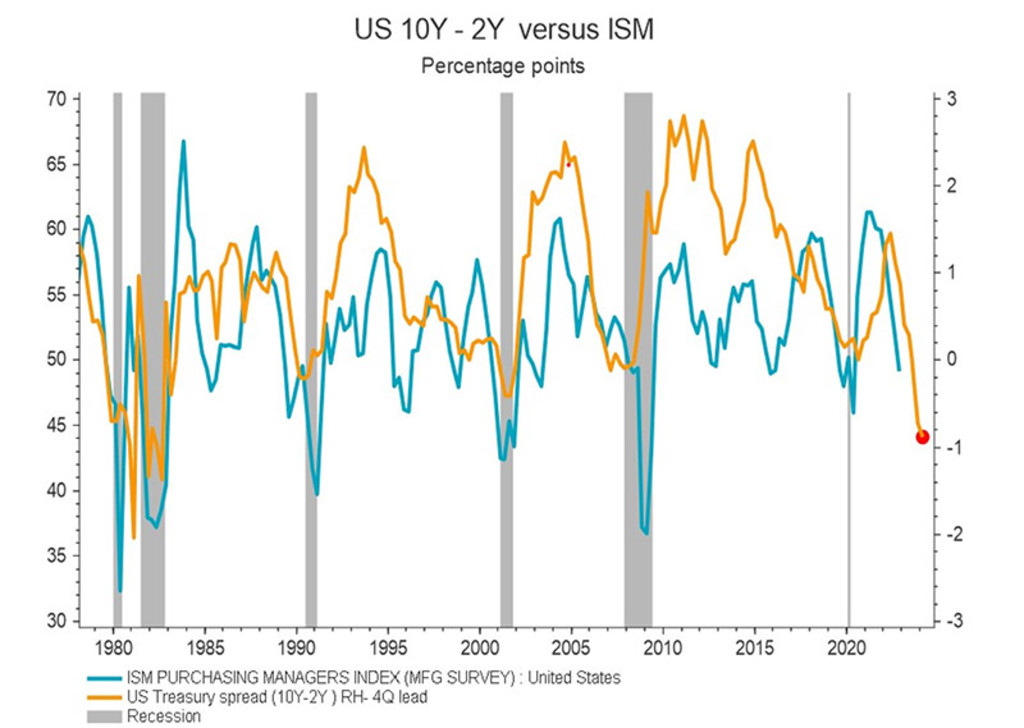
Inversion of the yield curve is a traditional indicator of an impending recession. Source: Refinitiv Datastream, Robeco
“Timing is of the essence here, as the lags between the yield curve inversion signal and the subsequent economic fallout are highly variable, with the potential to wrongfoot both macro bulls and bears post-inversion. For instance, when the yield curve inverted in August 2005, it took still 29 months before the onset of an NBER recession in 2008, even though the average lag is 16 months.”
Get the latest insights
Subscribe to our newsletter for investment updates and expert analysis.
Inflation versus unemployment
Secondly, there is the mismatch between rising inflation and falling unemployment. “While there is much to cheer about the resilience of the consumer on the back of continuing tight labor markets, a cyclical low in unemployment rates as we observe today, with US unemployment at 3.4%, is a contrarian signal for future economic activity,” Van der Welle says.
“Whenever the US unemployment rate drops below 5% and inflation edges above 4%, a recession ensues in the subsequent two years 100% of the time. Such a strong base rate leaves little room for complacency about the risks facing the US medium-term growth outlook.”
“This view can be further substantiated by looking at the steep drop in housing market sentiment, which serves as a leading indicator for US unemployment. As the decision to buy a house is strongly determined by perceived future job security, the deterioration in buyer sentiment signals that a significant turn in the labor market might be ahead.”
Highly unstable equilibrium
The third reason for a peak Goldilocks scenario is the recent episode of stronger-than-expected disinflation in conjunction with positive macro surprises. “This represents a highly unstable equilibrium,” Van der Welle says.
“While the disinflation process itself might not be at risk, the pace of disinflation could slow – inflation surprise indices edged higher already last month – and take some shine off the Goldilocks appeal.”
“Economic momentum has improved in advanced economies, with the global PMI above 50 again (signaling economic expansion) for the first time in six months. While commodity prices have declined by 3.3% in the year to date, a continued recovery in manufacturing activity led by Asia could slow the pace of headline disinflation.”
Inflation is still up
Meanwhile, the much-feared core PCE inflation has increased in recent months, and the data shows that almost half of its rise is still related to the supply side of the economy.
“Although supply chain problems have notably eased, another strong positive supply side shock through investments would be needed to remove sticky inflation elements from several economic sectors,” Van der Welle says.
“All in all, inflation might prove to be stickier until a recession enters the scene, as this phase of the business cycle typically triggers strong disinflation. In the meantime, central banks could feel they have to do more to bring down aggregate demand, which implies a larger drag on the economy and financial markets further down the road.”
Important information
THIS WEBSITE IS SOLELY INTENDED FOR PROFESSIONAL INVESTORS, WHICH HAS THE MEANING ASCRIBED TO IT IN THE SECURITIES AND FUTURES ORDINANCE (CAP. 571 OF THE LAWS OF HONG KONG) AND ITS SUBSIDIARY LEGISLATION. Investment involves risks. Past performance is not indicative of future performance. The information contained in this website is provided for reference only and does not constitute investment advice or an offer or solicitation to buy or sell in any securities or to adopt any investment strategy. Investors should not base their investment decisions solely on the information provided on this website and are advised to seek independent advice (including advice on tax implications) before making any investment decisions. Investors should ensure they fully understand the risks associated with the investment products and should also consider their own investment objectives and risk tolerance level. The investment decision is yours. You should not invest unless the intermediary who sells you the investment products has advised you that it is suitable for you and has explained how it is consistent with your investment objectives. Please refer to the relevant offering documents or other legal documents for further details including the risk factors. This website is published by Robeco Hong Kong Limited which is regulated by the Hong Kong Securities and Futures Commission (“SFC”) (CE No. APU851). This website has not been reviewed by the SFC. No assurance can be given that the investment objective of any investment products will be achieved. No representation or promise as to the performance of any investment products or the return on an investment is made. The value of investments may fluctuate. Past performance, projections, or forecasts included in this website should not be regarded as guarantees or indications of future performance, and no express or implied warranty is provided. The contents of this website are based on sources believed to be reliable, but due to the nature of information delivery technology and the necessity of using multiple data sources, including third party content, their accuracy is not guaranteed. The opinions expressed are as of the date shown above and may change as market conditions evolve, and are subject to change without notice. These opinions may differ from those of other Robeco investment professionals. Robeco accepts no liability for any direct, indirect, or consequential loss arising from the use of this material or any comments, opinions, or estimates contained herein. Robeco has no duty to update this website or any website content. Materials on this website may not be reproduced, distributed, or published without prior written permission from Robeco. Unless otherwise specified, Source: Robeco.