

Co-Portfolio Manager

• Insight
The energy shock will accelerate investment in smart energy solutions
Today’s energy markets are polluting, inefficient, volatile and vulnerable. The need for an energy transition has never been clearer and will be driven by electrification of end-use applications. Investments will be costly, but resistance has been lowered by the ongoing realities of high volatility, supply disruption and the need for domestic manufacturing that is both clean and energy efficient.
Summary
- Current power systems victim of and contributor to geopolitical instability
- Electrification is key for a clean and secure energy future
- We’re on the cusp of a new investment cycle for a complex transition
Energy is critical for economic growth, but it is dominated by fossil fuels. Oil, coal and gas account for more than 80% of the primary energy needed to power the world’s economies. The Paris Agreement and the transition to a net-zero economy mean the shift to renewables and other low-carbon sources will accelerate in the next decade and ultimately supplant fossil fuels’ preeminence. But though momentum has increased, we cannot get there fast enough.
With 80% of total CO2 emissions, we always knew the energy sector was dirty. But the recent convergence of crises has underscored additional dangers. It is extremely inefficient; 60% of the fossil fuels extracted are wasted, with half lost in the production of electricity, and another half lost when fuels are inefficiently burned during combustion. It is highly vulnerable due to dangerous dependencies on countries rich in fossil fuels but poor at diplomacy and governance. And it is volatile; the conflict in Ukraine took energy markets off-guard, amplifying the rise in energy prices.
In order to limit extreme global warming, nearly 75% of global electricity generation must come from low-emission sources by 2030
Clean energy requires electrification of consumption
Decarbonizing can only happen when burning hydrocarbons in engines and furnaces is replaced with racing electrons in a circuit. But that future reality depends not only on producing clean energy via renewables but also on clean consumption downstream via electric end-use applications (See Figure 1).
In order to limit extreme global warming, nearly 75% of global electricity generation must come from low-emission sources by 2030. Currently, wind and solar account for only 6% of the global mix. To reach net zero, electricity consumption needs to outgrow energy consumption by a factor of two to three in the coming decades. This will be driven not only by transport markets (via lithium-ion batteries, vehicle powertrains, green hydrogen and passenger railways), but also buildings (via electric heat pumps, HVAC and insulation), and industrial markets (via the electrification of production processes).
The world’s largest economies have already set ambitious targets to increase the share of renewables in the national energy mix, including the US where the recently passed Inflation Reduction Act (IRA) devotes nearly USD 400 billion to building up domestic renewable energy production and storage as well as clean energy use by consumers.
Figure 1 | Synchronized solutions – renewable energy supplies rise to support electric consumption
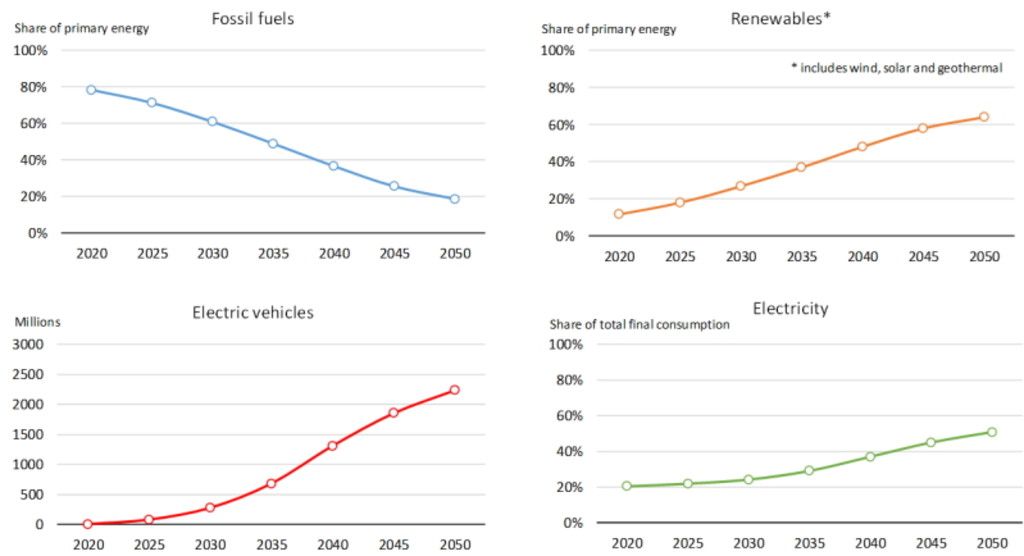
Renewable energy supplies will increase to support the electrification of end use applications.
Source: BP outlook
Driving not derailing the energy transition
Meanwhile, energy security has replaced climate security as an immediate concern, especially for Europe. Russia has cut EU gas supplies as tensions over the war in Ukraine have escalated, leaving the EU desperate for energy to keep its lights on, its citizens warm and its economies churning.
In the short term, countries are reverting to fossil fuels to fill the gap, but as geopolitical tensions tighten, the crisis emphasizes the high-stakes jeopardy of an economy dependent on fossil fuels. Recognizing this, the EU has acted swiftly to further accelerate its net-zero path. Its “REPowerEU” plan further cuts energy emissions, boosts electrification of buildings and industries, and expands investment in renewable supplies and infrastructure connections across bloc economies.
But the trade-offs between energy security and climate security are complicated by current technological capacity but also political will and public sentiment, especially if consumers are forced to ration.

Facts you didn’t know about the energy transition
Unleashing the power of Smart Energy!
High energy costs create incentives
Per the International Energy Agency, in order to reach net-zero emissions by 2050, annual investment needs to double to USD 5 trillion a year. Energy costs comprise a significant share of total expenses in a variety of business models, which means a company’s energy savings often have an outsized effect on the bottom line.
The benefits of transitioning will accrue in the long term, but over the short term many firms will see significant costs, especially in hard-to-electrify industries. However, renewable production costs are falling relative to traditional energy forms (see Figure 2). And with traditional energy costs exploding, consumers and energy-intensive industries will accelerate their own energy transitions as payback periods for investments in renewable energy procurement and energy-efficient solutions shorten.
Figure 2 | Renewables – cost competitive in industry and residential settings
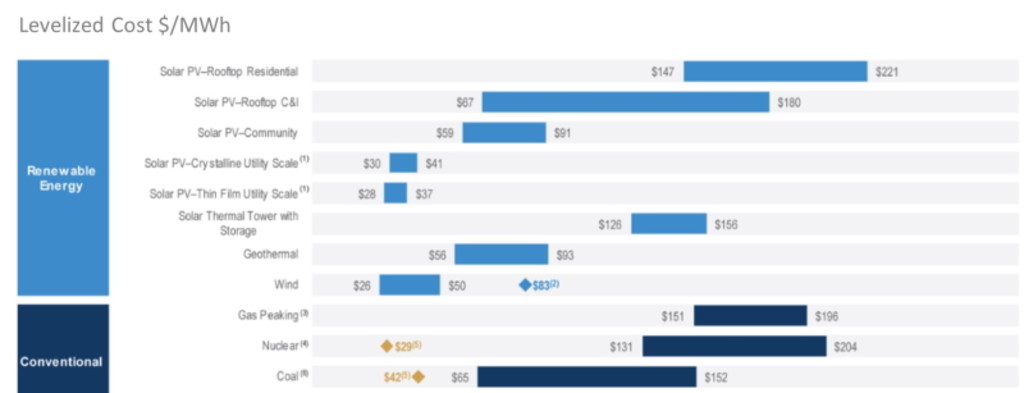
The levelized cost of energy from renewable sources (solar installations, geothermal and wind) are competitive and in industrial settings much lower than conventional forms of energy such as gas, coal and nuclear.
Source: Lazard
Targeted investment in electrification
Despite present challenges, electrification is at the beginning of a huge investment cycle which will spill across sectors. We believe we are reaching a turning point where governments will stop incentivising combustible fuels and encourage the adoption of technologies that facilitate economies running fully on electricity. As the fuel mix diversifies and customers are granted more flexibility, competition between energy sources will increase. This will further accelerate economy-wide shifts in renewables and electrification.
The Smart Energy team invests in companies enabling and accelerating the transition along the entire electrification value chain – from upstream companies supporting the generation of renewable wind and solar power to mid- and downstream companies creating more efficient ways to use, store and distribute it. Alongside investments in maturing technologies, the team is continuously looking for companies that can simplify and scale production of breakthrough solutions that will further accelerate the electrification of the economy.
Important information
THIS WEBSITE IS SOLELY INTENDED FOR PROFESSIONAL INVESTORS, WHICH HAS THE MEANING ASCRIBED TO IT IN THE SECURITIES AND FUTURES ORDINANCE (CAP. 571 OF THE LAWS OF HONG KONG) AND ITS SUBSIDIARY LEGISLATION. Investment involves risks. Past performance is not indicative of future performance. The information contained in this website is provided for reference only and does not constitute investment advice or an offer or solicitation to buy or sell in any securities or to adopt any investment strategy. Investors should not base their investment decisions solely on the information provided on this website and are advised to seek independent advice (including advice on tax implications) before making any investment decisions. Investors should ensure they fully understand the risks associated with the investment products and should also consider their own investment objectives and risk tolerance level. The investment decision is yours. You should not invest unless the intermediary who sells you the investment products has advised you that it is suitable for you and has explained how it is consistent with your investment objectives. Please refer to the relevant offering documents or other legal documents for further details including the risk factors. This website is published by Robeco Hong Kong Limited which is regulated by the Hong Kong Securities and Futures Commission (“SFC”) (CE No. APU851). This website has not been reviewed by the SFC. No assurance can be given that the investment objective of any investment products will be achieved. No representation or promise as to the performance of any investment products or the return on an investment is made. The value of investments may fluctuate. Past performance, projections, or forecasts included in this website should not be regarded as guarantees or indications of future performance, and no express or implied warranty is provided. The contents of this website are based on sources believed to be reliable, but due to the nature of information delivery technology and the necessity of using multiple data sources, including third party content, their accuracy is not guaranteed. The opinions expressed are as of the date shown above and may change as market conditions evolve, and are subject to change without notice. These opinions may differ from those of other Robeco investment professionals. Robeco accepts no liability for any direct, indirect, or consequential loss arising from the use of this material or any comments, opinions, or estimates contained herein. Robeco has no duty to update this website or any website content. Materials on this website may not be reproduced, distributed, or published without prior written permission from Robeco. Unless otherwise specified, Source: Robeco.